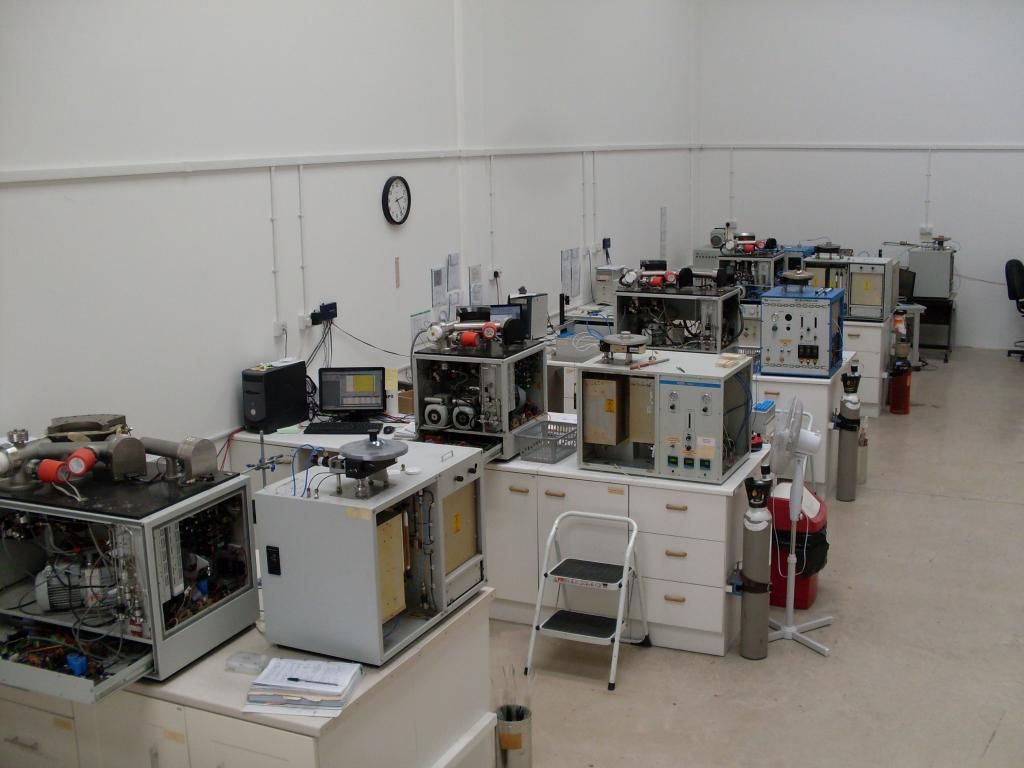
It has often been mentioned to me by researchers that a project that generates somewhere between 10,000 and 20,000 samples would cost about the same to send them to us for analysis, as it would to purchase their own IRMS system (about $200,000). That is true. However, it is worth thinking a little deeper before spending that hard earned research grant money on your own mass spectrometer.
Other Costs
A new IRMS costs money to run. First the correct environment needs to be put in place which means a good clean power supply, temperature control (usually air conditioning), plenty of space to allow all round access to the equipment and high purity helium, oxygen and probably reference gases on tap. High quality consumables (quartz glassware, various chemical packings, combustion boats/cups) have to bought from specialist suppliers and are used in the analysis of each and every sample and reference material. While some reference materials can be bought in, it is necessary to set up at some cost a wide range of reliable, traceable working laboratory standards that need to be used on a daily basis. The equipment needs to be serviced which often means taking out an annual service contract with the manufacturer. Finally and probably most importantly there is the cost of the technician to prepare the samples (including any pre-analysis work up) run and maintain the instrument and analyze the data to check that it is both good and true. Despite the best efforts of IRMS manufacturers, the instruments today are still a long way from being (and probably never will be) black box technology so the right operator is of paramount importance.
Getting the best out of the instrument
Mass spectrometers, especially the isotope ratio variety, break down quite a lot. While service contracts are designed to help the user, the response time for an engineer to visit may be quite slow compared to more common scientific instruments. This is quite normal for a 'specialist' instruments because there are only a few 'specialist' engineers to go round. Quite often they have to visit you direct from the factory and therefore the further your lab is away from the factory, the longer the response time will be. In order to minimize instrument down time it is best if you can diagnose and fix the common failures yourself and this also means having access to some testing equipment and a stock of some expensive spare parts. While a single instrument can be fitted with a variety of sample preparation interfaces e.g. elemental analyser, gas handling device, dual-inlet and GC combustion interface, this in itself can lead to instrument down time. Switching from one interface to another often involves some manual work, connections have to be checked for leaks and there is always a 'settling' time while you wait for the new set up to become stable. Even apparently simple procedures of changing the elemental analyser from analysing one isotope to another, can lead to one or more days of downtime and the waste of expensive consumables if there are only a few samples that require a particular isotope measured.
Using an Analytical Service instead
The service we provide removes all of the above worries ensuring that you get your data on time and that the grant money is spent on publishing those results rather than buying an expensive piece of equipment. The key to providing this is our ability to keep the equipment running and having the facility to run different samples for different isotopes on five dedicated IRMS systems. Not to mention that the analysis is done by highly experienced operators and support staff that know how to deal with many different types of sample and how to obtain the best results for each. With the discount we provide for academic research and the potential for sending samples in part-state of readiness (e.g. pre-capsulated), you may be suprised just how far your research grant might stretch.
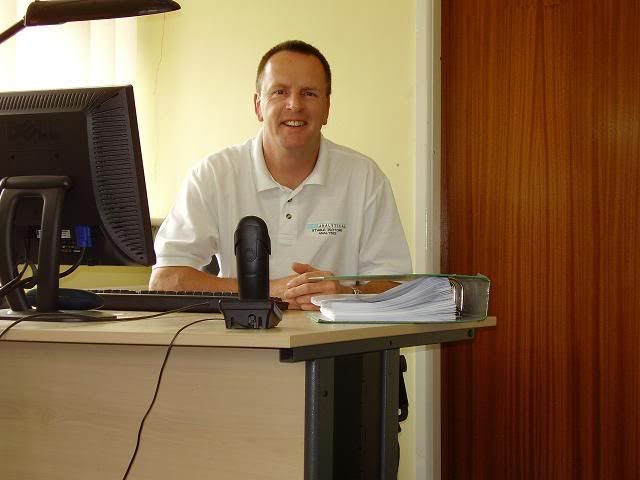
Steve Brookes
Thursday, 23 August 2007
Wednesday, 22 August 2007
Mini Fractionation of Crude Oil
Analysis of crude oils is often undertaken to evaluate source rocks and their depositional environments. Carbon isotope analysis of the saturate and aromatic fractions of the oil as part of the testing process, is used to identify if the oil is of terrestrial or marine origin.
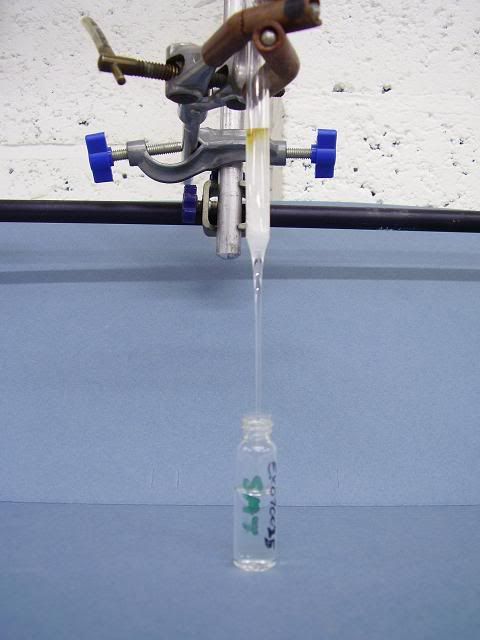
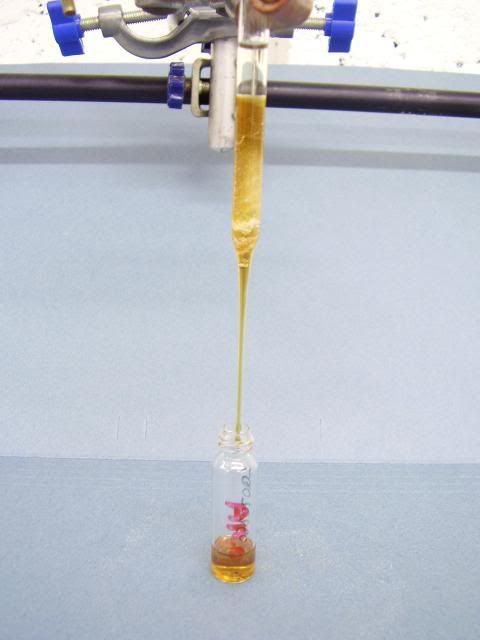
The carbon isotope analysis requires less than a milligram of each fraction for analysis so in our lab we use a 'mini fractionation' procedure to prepare the two fractions. This involves using a glass pasteur pipette as column to hold a bed of activated silica gel. A few microlitres of the crude oil sample is placed on top of the bed and the saturate fraction eluted with with hexane (picture on left). Once all the saturates have been washed through, the aromatics are eluted with toluene (picture on right). Each fraction is then blown dry under nitrogen and are then analysed on one of the EA-IRMS systems.
This simple and robust procedure for obtaining carbon-13 data that can be used to identify the source of the crude oil was developed in collaboration with one of our clients, Dr Matthew Kaye of OceanGrove Geoscience Ltd.
Monday, 20 August 2007
New Water Isotope Standards


Over recent months we have prepared and calibrated a new set of working laboratory water standards and are making them available for sale to others that have a need for them. The deuterium and oxygen-18 abundances of the standards have been measured against (and are therefore traceable to) the new V-SMOW2 and SLAP2 international reference waters that are distributed by the IAEA. Each standard was subjected to our full calibration procedure which involves analysis of multiple replicates over a number of days.
The set of 5 standards covers a broad range of water isotope abundances making them suitable as working references for both natural and tracer studies. Details of the five standards are and their delta values vs V-SMOW2/SLAP2 in permil notation are (2H value, 18O value):
- IA-R052 (low abundance natural water) -157.12, -19.64
- IA-R053 (mid abundance natural water) -61.97, -10.18
- IA-R054 (zero abundance natural water) +4.93, +0.56
- IA-R055 (mid abundance enriched water) +843.43, +108.59
- IA-R056 (high abundance enriched water) +1701.83, +266.83
Each standard is provided in a 30 mL re-useable robust glass bottle (although we advise removing aliquots to prevent accidental contamination) and is accompanied by a 'report of analysis'. Although we have prepared large quantities of each, customers will be limited to purchasing 5 bottles of each standard. Customers that need to set up large quantities of working laboratory standards may wish to consider using our 'Standards calibration service' as an alternative.
Monday, 9 July 2007
Report on SIMSUG 2007


My Thoughts on Simsug 2007 by Tanith Allwood
Newcastle University was the host for a well-attended SIMSUG meeting this year. There were a broad range of very interesting talks, with Simon Jennings (CEFAS) starting the proceedings as the Keynote speaker for the first day. Simon Jennings’ presentation on the use of Stable Isotopes in Food Web Analysis impressed many people with the sheer scale of his sample collection- he analysed several thousand samples and Iso-Analytical Ltd conducted most of the analyses. There were several presenters who had used Iso-Analytical Ltd for their analyses and it was good to be able to put faces to the names of the clients we’ve been working with and to be able to see where our work is going and what it is being used for. It was also interesting to see the advances in the methodology of IRMS, particularly the growing use of Compound Specific analysis and to see how people are using the techniques now and future applications and techniques. All in all it was a very interesting and very useful conference.

Profile of Tanith Allwood
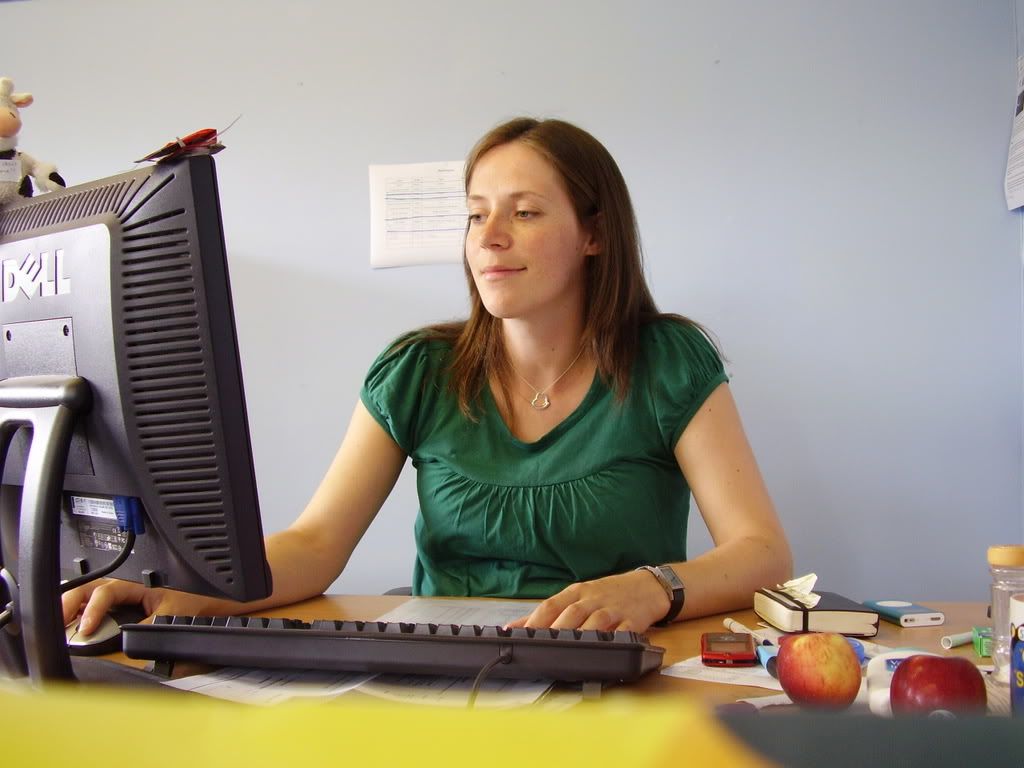
Tanith Allwood BSc (Hons) - Analyst
Tanith started working part time for Iso-Analytical in late 2003 while studying for her degree in Geography and Geology at Manchester University. After graduating with honours in 2005 she became a full time analyst with us.
In a relatively short period of time Tanith has become involved in all aspects of stable isotope analyis, from sample preparation through to operation of the mass spectrometers.
Thursday, 14 June 2007
Fifth IRMS System Commissioned
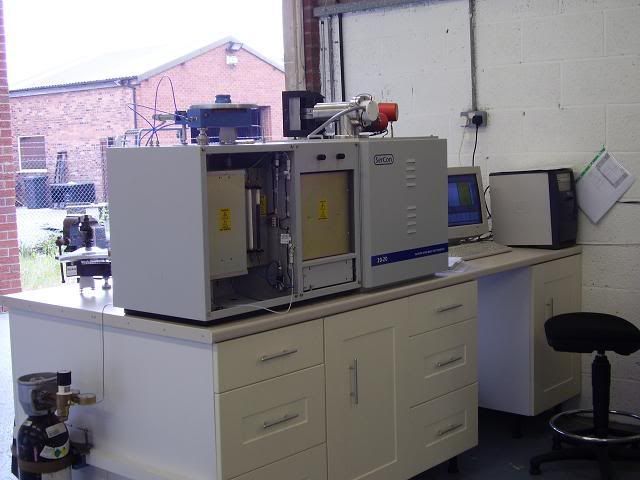
In order to keep up with the demand for analyses our IRMS system count rose to 5 last month. The new system was obtained from SerCon Limited and complements the other 4 systems.
Back in 2000 our first instrument had to be used to analyse all of the stable isotopes in lots of different sample types. Over time we have developed the analytical facility so that instruments are dedicated to particular isotopes and types of sample. This has enabled us to cope with 15,000+ samples we receive each year so that they are turned around in good time. Our facility is now made up of:
System 1 : Deuterium and oxygen-18 in water (equilibration) and solids (high temperature conversion)
System 2: Carbon-13 and nitrogen-15 in solids (EA-IRMS)
System 3: Carbon-13 in gases, carbonate isotopes and overflow for system 2
System 4: Sulphur-34 in solids (EA-IRMS)
System 5: Overflow for systems 2 and 4.
Meet the Support Staff

Margaret Anderson (left) - Technician
Anne Bruce (middle) - Technician
Tina Ringrose (right) - Administration
Tina, Anne and Margaret are three of the key elements in getting your samples analysed. Many will know Tina through e-mail and phone contact as one of her roles is to log in your samples when they arrive at the lab.
Anne and Margaret are the ones that supply the care and attention that is required to prepare your samples for analysis on the instruments.
Subscribe to:
Posts (Atom)