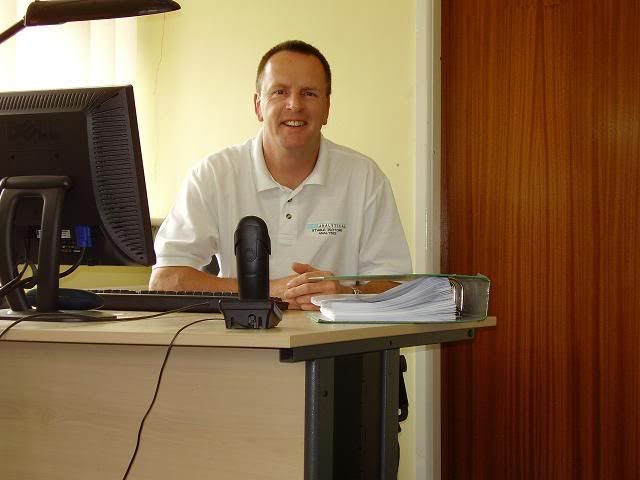
It was around this time last year that we started to see an increase in the demand for analysis of samples. That demand has remained in place and I can safely say that our lab has never been busier. This is good news and not so good news. Good news because it is very encouraging to see that so many of you are increasing the amount of research that you are using stable isotopes for. The not so good news is that the increased number of samples that we have been receiving has meant that the lead time for analysis has increased for most sample types.
In order to meet the increased demand, we did two things in the first quarter of this year. First off, we re-furbished and upgraded one of the mass spectrometers that was under-utilized. This has given us extra capacity for high temperature continuous flow - IRMS and extra capacity for deuterium measurements. Secondly, we recruited another person for the technical support staff, Joanna Bruce. Joanna has already been trained up to prepare samples and is now doing so on a day to day basis alongside the rest of the team (Anne, Margaret and Sharon).
Even with this extra capacity in place the lead times for analysis are still longer than they used to be and what we would like them to be. We apologize to you for that but would also like to thank all of our customers for your patience. All samples that arrive at our facility are logged in, in the order that they are received and join the queue behind orders that have already arrived. We think and hope that this is the fairest way for all of our customers.
It is good to know that people are willing to wait a bit longer because of the quality of the service that we provide.
Friday, 1 July 2011
Thursday, 20 May 2010
Row for Heroes
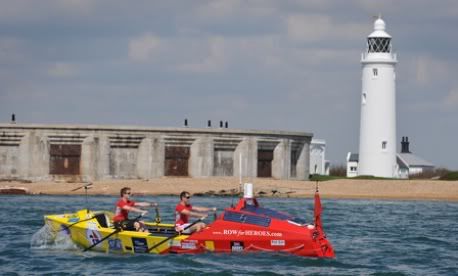
On Wednesday 12th May 2010, two Army Doctors, Nick Dennison and Hamish Reid, set out to Row around Great Britain in order to raise money for Help for Heroes and the Army Benevolent Fund. In doing so they will enter the record books by being the first pair to complete this Herculean task.
The charity rowers wanted to monitor their energy expenditure during the challenge. So we at Iso-Analytical volunteered to help out by providing them with a doubly labelled water kit which they could use during the trip. The kit consisted of doubly labelled water drinks, collection containers for urine samples and everything needed to keep records of the sampling times:
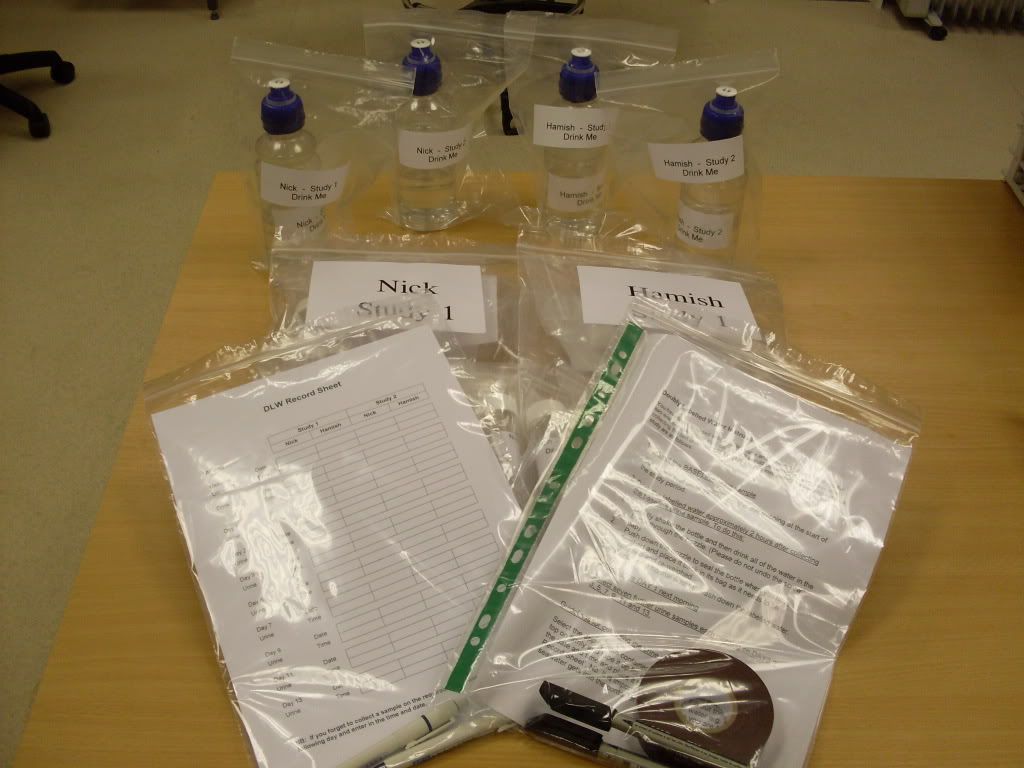
On their return we will measure the two sets of urine samples that they will have collected from two study periods. Measuring the differential loss of deuterium from the body (only lost as water) and oxygen-18 (lost as water and carbon dioxide) allows us to calculate their total energy expenditure over study periods as long as two weeks. We're expecting Nick and Hamish's energy expenditures to be somewhat higher than normal!
To find out more about the challenge, track their progress and the charity they are supporting, please visit their website: Row for Heroes

Thursday, 25 March 2010
Iso-Analytical Student Award Provides a First for Deuterium Analysis
Unravelling complexities in benthic food webs using a dual stable isotope (hydrogen and carbon) approach.
Peter Deines, Matthew J. Wooller and Jonathan Grey, Freshwater Biology (2009) 54, 2243-2251.
In the journal article above the authors provide preliminary evidence to suggest that hydrogen and carbon isotope values in macroinvertebrates may be used to distinguish between methane formation pathways and help to explain inter-depth and inter-specific differences between co-existing chironomid species found in the same lake.
Peter Deines of the Max Planck Institute for Limnology, Plon, Germany used his Iso-Analytical Student award to send samples to our laboratory for analysis. Samples of chironomid larvae collected from German lakes were measured for their deuterium abundance. As far as the authors are aware this is the first study to use deuterium as a second biochemical marker in combination with carbon-13 (measured in their own laboratory), to unravel linkages between microbial fauna in sediment and macroinvertebrate consumers.
Peter Deines, Matthew J. Wooller and Jonathan Grey, Freshwater Biology (2009) 54, 2243-2251.
In the journal article above the authors provide preliminary evidence to suggest that hydrogen and carbon isotope values in macroinvertebrates may be used to distinguish between methane formation pathways and help to explain inter-depth and inter-specific differences between co-existing chironomid species found in the same lake.
Peter Deines of the Max Planck Institute for Limnology, Plon, Germany used his Iso-Analytical Student award to send samples to our laboratory for analysis. Samples of chironomid larvae collected from German lakes were measured for their deuterium abundance. As far as the authors are aware this is the first study to use deuterium as a second biochemical marker in combination with carbon-13 (measured in their own laboratory), to unravel linkages between microbial fauna in sediment and macroinvertebrate consumers.
Friday, 19 March 2010
SIMSUG 2010
28th to 30th April 2010, University of Exeter

The annual meeting of the Stable Isotope Mass Spectrometer Users Group (SIMSUG) presents an ideal opportunity to share our experiences of analysing stable isotopes both formally and informally. Registration for the meeting and accomodation and submission of abstracts is now open. More details can be found on the SIMSUG website which can be accessed at the link below:
SIMSUG 2010
Iso-Analytical are one of the sponsors of the meeting and will be in attendance throughout. I look forward to meeting new and existing customers and catching up with colleagues and friends I have met in the 30+ years I have been involved in research with stable isotopes.
Steve Brookes

The annual meeting of the Stable Isotope Mass Spectrometer Users Group (SIMSUG) presents an ideal opportunity to share our experiences of analysing stable isotopes both formally and informally. Registration for the meeting and accomodation and submission of abstracts is now open. More details can be found on the SIMSUG website which can be accessed at the link below:
SIMSUG 2010
Iso-Analytical are one of the sponsors of the meeting and will be in attendance throughout. I look forward to meeting new and existing customers and catching up with colleagues and friends I have met in the 30+ years I have been involved in research with stable isotopes.
Steve Brookes
Tuesday, 9 February 2010
Inter-laboratory Testing - Honey
Food analysis using Isotopic Techniques - Proficiency Testing Scheme.
Results of carbon-13 and nitrogen-15 analysis of Honey undertaken in the first round of 2008 are shown below. The Z-scores (see explanation below the charts) show that the participating laboratories were in good agreement with each other and our own Z scores are comfortably in the desired range.


The evaluation of data is performed according to the ISO/IUPAC/AOAC International Harmonised Protocol for Proficiency Testing of analytical laboratories. Individual laboratories results are expressed as Z-scores:
Z = (x-X)/s
Where :
x is the reported result from the participating laboratory.
X is the assigned or "true" value for the analyte being determined. In this exercise the assigned values are taken as the robust mean of all reported results.
s is the target value for standard deviation. In this exercise the target SD values are derived from recently reported collaborative trial results or from the robust standard deviation of all reported values.
If X and s are good estimates of the population mean and standard deviation, and the underlying distributions are normal, Z is normally distributed with a mean of zero and unit standard deviation.
Results of carbon-13 and nitrogen-15 analysis of Honey undertaken in the first round of 2008 are shown below. The Z-scores (see explanation below the charts) show that the participating laboratories were in good agreement with each other and our own Z scores are comfortably in the desired range.
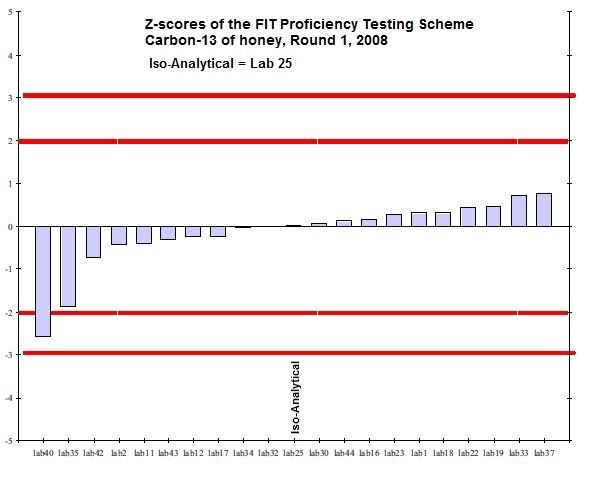
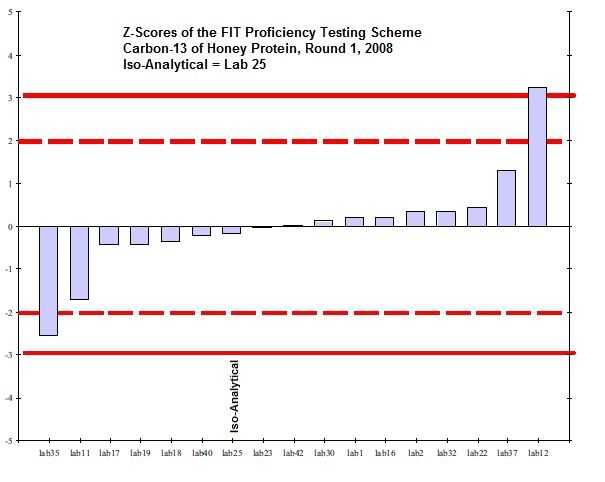
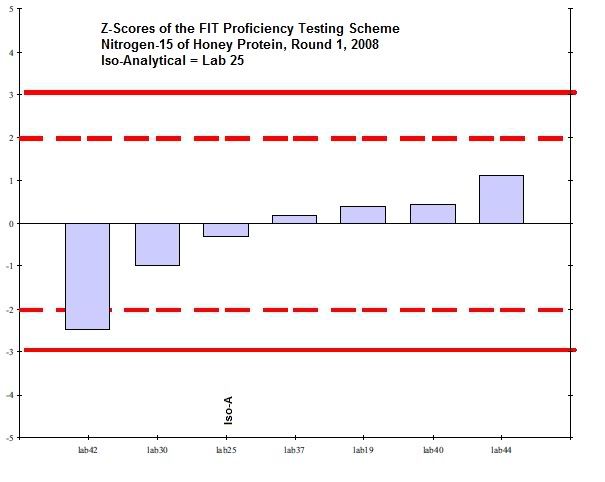
The evaluation of data is performed according to the ISO/IUPAC/AOAC International Harmonised Protocol for Proficiency Testing of analytical laboratories. Individual laboratories results are expressed as Z-scores:
Z = (x-X)/s
Where :
x is the reported result from the participating laboratory.
X is the assigned or "true" value for the analyte being determined. In this exercise the assigned values are taken as the robust mean of all reported results.
s is the target value for standard deviation. In this exercise the target SD values are derived from recently reported collaborative trial results or from the robust standard deviation of all reported values.
If X and s are good estimates of the population mean and standard deviation, and the underlying distributions are normal, Z is normally distributed with a mean of zero and unit standard deviation.
Tuesday, 24 November 2009
Almost one year on
It's hard to believe that it will soon be a year since we moved into the new laboratory here in Crewe. All of the initial teething troubles are now out of the way and I'm glad to say that we're now settled for the years to come. All areas of the new building are now a lot more organised, leaving us free to concentrate on the day to day analysis of the samples you send us.
The building now has our name above the door:

The main instrument area is fully functional:

So too is the sample preparation area:

We have a new technician, Sharon Hinett, working on the team:

And the office areas are a much better place to work in:

There is plenty of space for storage of standards, spares and our (your) sample archive:

The building now has our name above the door:
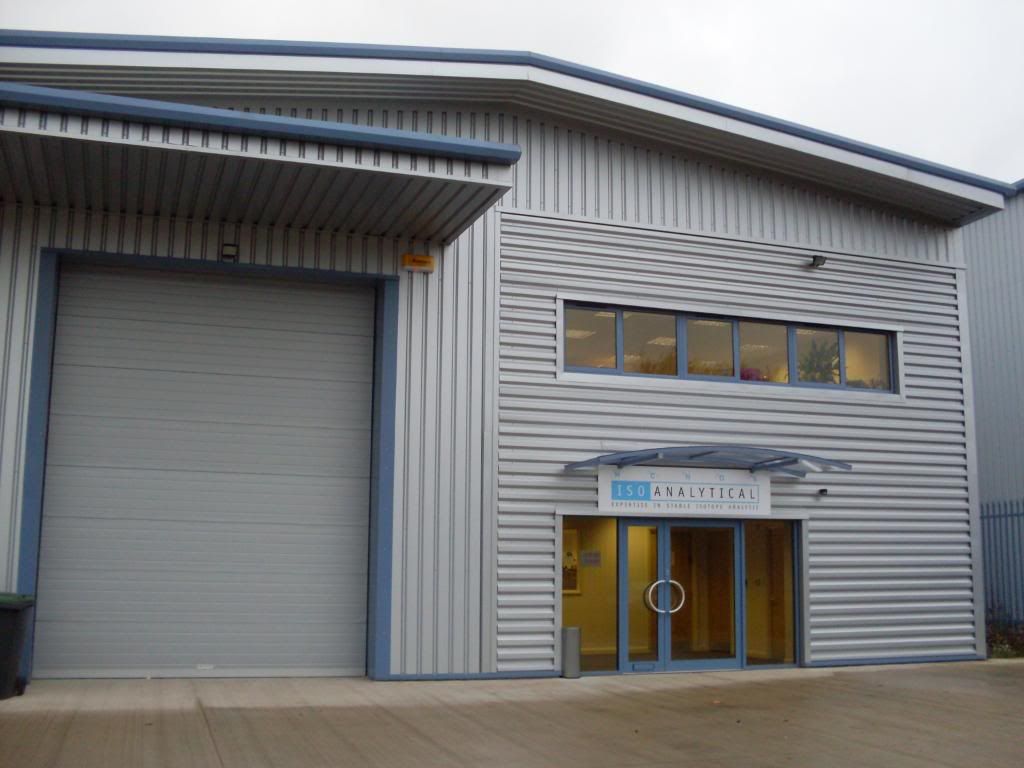
The main instrument area is fully functional:

So too is the sample preparation area:
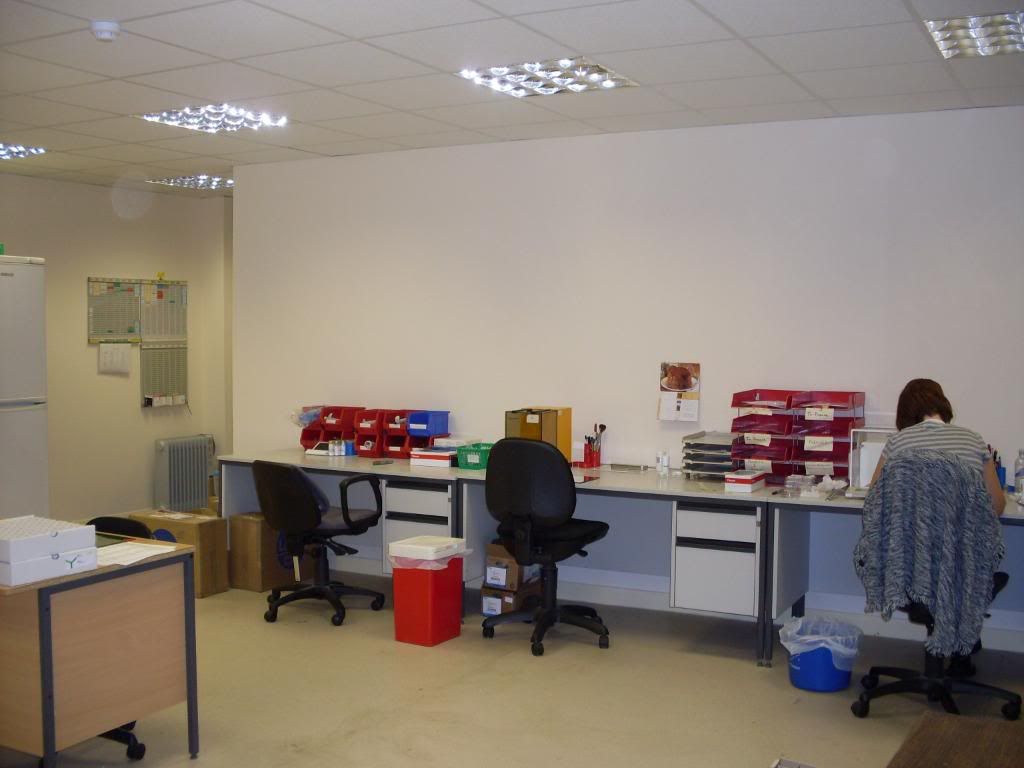
We have a new technician, Sharon Hinett, working on the team:
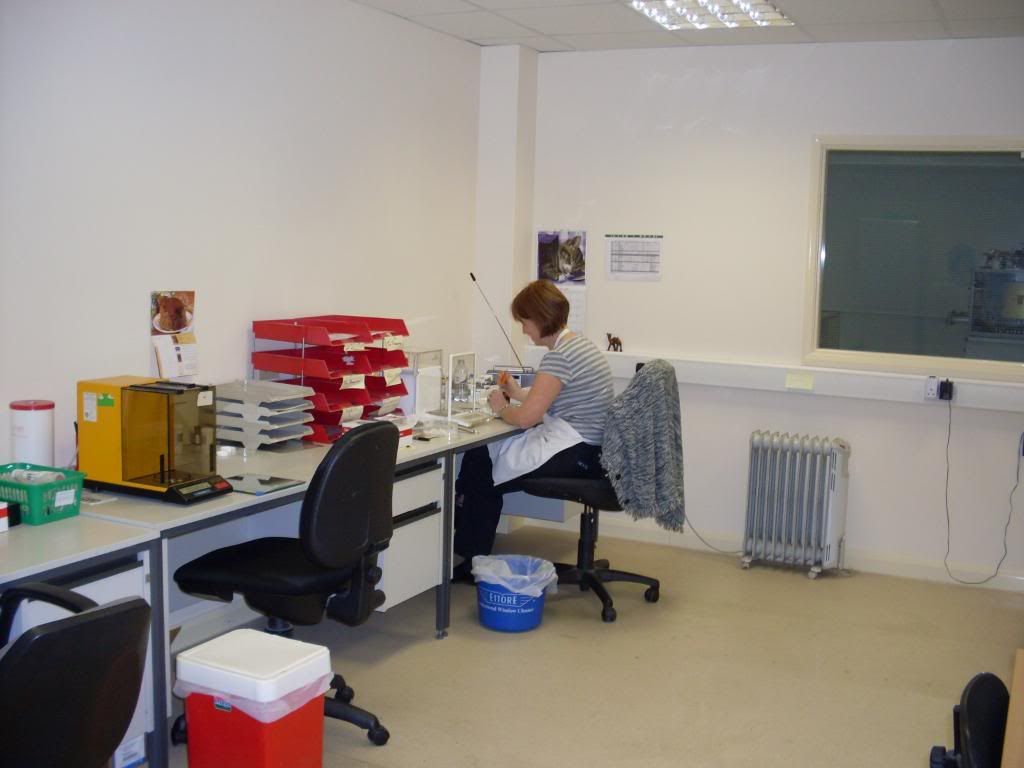
And the office areas are a much better place to work in:
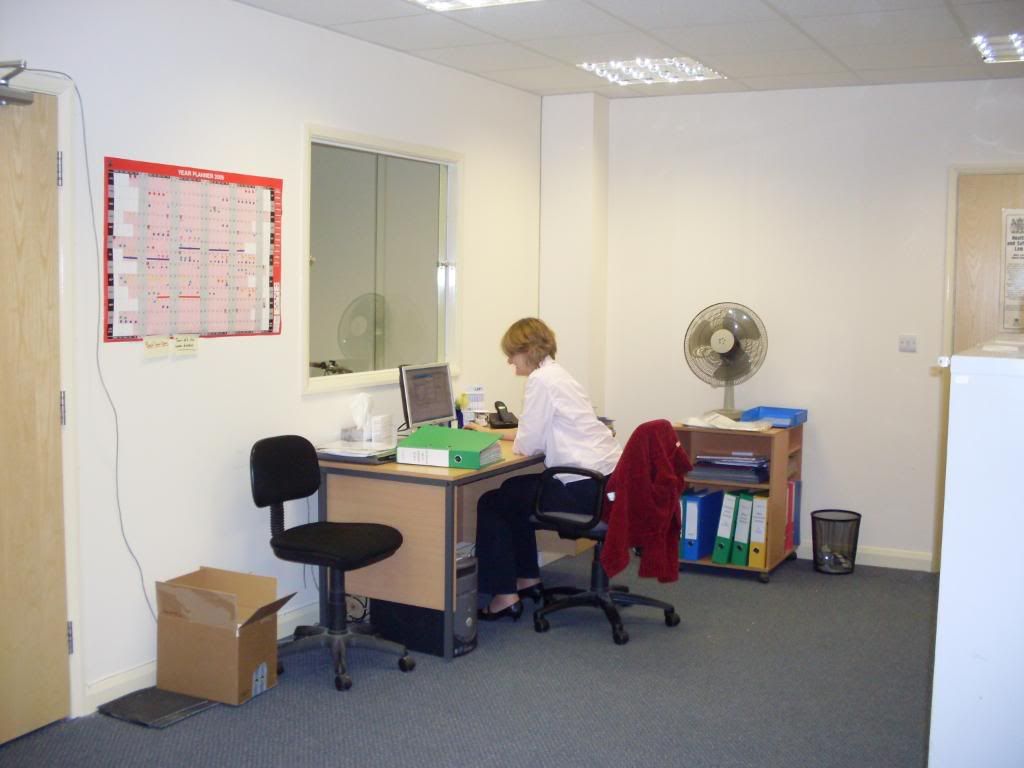
There is plenty of space for storage of standards, spares and our (your) sample archive:

Monday, 20 April 2009
Thank You for Your Patience
I am please to say that we are well and truly settled in our new laboratory and offices and back up to speed with all of our normal services. The move cost us at least a month of analysis time which immediately impacted on the turnaround of results. So at the current time all orders are running behind the normal schedule. We must have a lot of busy customers out there because the backlog caused by the move has been compounded by an extraordinary influx of samples this year. We're currently running the instruments 7 days to keep up with the demand and have just taken on a new technician to help with sample preparation.
I would like to thank all of our customers for their patience at this time while we try to get to their samples, which are being analysed in the order in which they are received.
While our website and e-mail addresses have not been affected by the move, it was necessary to get new telephone numbers. These are now:
Tel: +44 (0)1270 509533
Fax: +44 (0)1270 509511
Steve Brookes
I would like to thank all of our customers for their patience at this time while we try to get to their samples, which are being analysed in the order in which they are received.
While our website and e-mail addresses have not been affected by the move, it was necessary to get new telephone numbers. These are now:
Tel: +44 (0)1270 509533
Fax: +44 (0)1270 509511
Steve Brookes
Subscribe to:
Posts (Atom)